IX
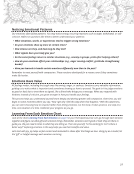
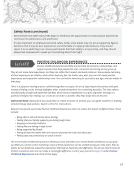
There are a number of small group discussion activities so you will want to establish a protocol to bring
everyone’s attention back to you. Some ideas include “You’ve got 10 seconds to wrap up your last thought.”,
“Clap once if you can hear me clap twice if you can hear me.”, “Finish the sentence you’re on and bring your
attention back.”, “Hands up means voices off.” Find something that works for you and the participants you
are working with.
Mind Matters is designed to be taught in 12 to 13 one- to two-hour classes, if you include the Bonus Lesson
on Gratitude. The foundation of Mind Matters is the creation of new habits of thinking and behavior. This
type of change takes time, effort, determination, and concentration to accomplish. Therefore, the skills
taught in this curriculum develop over time with practice.
Teaching this curriculum in six- to eight-hour segments is generally not as effective as delivering it over a
longer period of time. However, some programs have adapted it successfully. For example, staff from a
Head Start program reported positive results when they used the curriculum as part of a weekend retreat.
It is critical for the success of this program that you are experienced with Mind Matters skills. Before you
teach these skills, we recommend that you give yourself the opportunity to learn and practice them. In
addition, it is essential, as an instructor, that you create a personal growth plan and develop your own
personal practice. By doing these exercises, you will be modeling the desired behavior for your participants
as well as improving your effectiveness as an instructor. As you continue to apply these activities to your life,
you—along with your participants—will benefit too.
Each lesson follows the same basic outline. This approach provides predictability for participants, which
helps to increase their sense of comfort and safety.
The basic outline of each lesson:
1. Review previous session’s activities
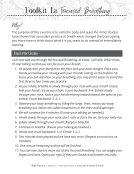
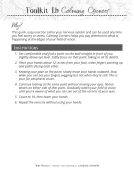
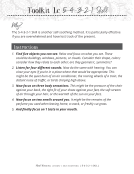
2. Complete a self-regulation/self-soothing exercise
3. Introduce a new skill with a mini-lecture
4. Learn and practice the skill
5. Briefly review the benefits and use of the skill
6. Complete a practice plan to implement the skill beyond the classroom
7. Conclude with a self-regulation/self-soothing exercise
Reminder: For maximum impact, we recommend that each class begin and end with a self-regulation/
self-soothing exercise. We recognize that time may be limited and you may need to cut short some of the
self-regulation/self-soothing exercises.
When teaching Mind Matters, use your own stories and examples whenever possible instead of Carolyn’s.
Carolyn’s stories are included to model lesson concepts and provide a backup. Research shows that
participants are more likely to engage, remember, and apply skills when examples come from the instructor
they know and trust. Especially when it is shared in ways that feel authentic and relevant. In educational
and trauma-informed settings, relational trust, safety, and connection increase attention, motivation, and
participant buy-in. Everyday examples are often the most effective.
Instructor Guidance
There are a number of small group discussion activities so you will want to establish a protocol to bring
everyone’s attention back to you. Some ideas include “You’ve got 10 seconds to wrap up your last thought.”,
“Clap once if you can hear me clap twice if you can hear me.”, “Finish the sentence you’re on and bring your
attention back.”, “Hands up means voices off.” Find something that works for you and the participants you
are working with.
Mind Matters is designed to be taught in 12 to 13 one- to two-hour classes, if you include the Bonus Lesson
on Gratitude. The foundation of Mind Matters is the creation of new habits of thinking and behavior. This
type of change takes time, effort, determination, and concentration to accomplish. Therefore, the skills
taught in this curriculum develop over time with practice.
Teaching this curriculum in six- to eight-hour segments is generally not as effective as delivering it over a
longer period of time. However, some programs have adapted it successfully. For example, staff from a
Head Start program reported positive results when they used the curriculum as part of a weekend retreat.
It is critical for the success of this program that you are experienced with Mind Matters skills. Before you
teach these skills, we recommend that you give yourself the opportunity to learn and practice them. In
addition, it is essential, as an instructor, that you create a personal growth plan and develop your own
personal practice. By doing these exercises, you will be modeling the desired behavior for your participants
as well as improving your effectiveness as an instructor. As you continue to apply these activities to your life,
you—along with your participants—will benefit too.
Each lesson follows the same basic outline. This approach provides predictability for participants, which
helps to increase their sense of comfort and safety.
The basic outline of each lesson:
1. Review previous session’s activities
2. Complete a self-regulation/self-soothing exercise
3. Introduce a new skill with a mini-lecture
4. Learn and practice the skill
5. Briefly review the benefits and use of the skill
6. Complete a practice plan to implement the skill beyond the classroom
7. Conclude with a self-regulation/self-soothing exercise
Reminder: For maximum impact, we recommend that each class begin and end with a self-regulation/
self-soothing exercise. We recognize that time may be limited and you may need to cut short some of the
self-regulation/self-soothing exercises.
When teaching Mind Matters, use your own stories and examples whenever possible instead of Carolyn’s.
Carolyn’s stories are included to model lesson concepts and provide a backup. Research shows that
participants are more likely to engage, remember, and apply skills when examples come from the instructor
they know and trust. Especially when it is shared in ways that feel authentic and relevant. In educational
and trauma-informed settings, relational trust, safety, and connection increase attention, motivation, and
participant buy-in. Everyday examples are often the most effective.
Instructor Guidance